A Wanderer Dances the Dance of Stars and Space
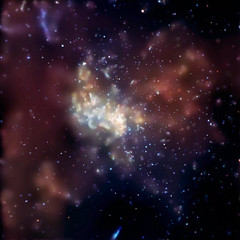
The supermassive black hole at the center of our Galaxy. by Smithsonian Institution
License (according to Flickr): No known copyright restrictions
License (according to Flickr): No known copyright restrictions
The Hubble Space Telescope captured a spectacular image of the bright star-forming ring that surrounds the heart of the barred spiral galaxy NGC 1097. In this image, the larger-scale structure of the galaxy is barely visible: its comparatively dim spiral arms, which surround its heart in a loose embrace, reach out beyond the edges of this frame. This face-on galaxy, lying 45 million light-years away from Earth in the southern constellation of Fornax (The Furnace), is particularly attractive for astronomers. NGC 1097 is a Seyfert galaxy. Lurking at the very center of the galaxy, a supermassive black hole 100 million times the mass of our sun is gradually sucking in the matter around it. The area immediately around the black hole shines powerfully with radiation coming from the material falling in.
A Wanderer Dances the Dance of Stars and Space
Additional Info:
Technology: Hubble Space Telescope
Overall Sentiment: 0.360288
Relevance: 0.826261
Site Meta Tags Info
Site Provided Keywords:
Site Provided Desc:
URL Provided Title:
Source Webpage: nasa.gov
Site Provided Desc:
The Hubble Space Telescope captured a spectacular image of the bright star-forming ring that surrounds the heart of the barred spiral galaxy NGC 1097. In this image, the larger-scale structure of the galaxy is barely visible: its comparatively dim spiral arms, which surround its heart in a loose embrace, reach out beyond the edges of this frame. This face-on galaxy, lying 45 million light-years away from Earth in the southern constellation of Fornax (The Furnace), is particularly attractive for astronomers. NGC 1097 is a Seyfert galaxy. Lurking at the very center of the galaxy, a supermassive black hole 100 million times the mass of our sun is gradually sucking in the matter around it. The area immediately around the black hole shines powerfully with radiation coming from the material falling in. The distinctive ring around the black hole is bursting with new star formation due to an inflow of material toward the central bar of the galaxy. These star-forming regions are glowing brightly thanks to emission from clouds of ionized hydrogen. The ring is around 5000 light-years across, although the spiral arms of the galaxy extend tens of thousands of light-years beyond it. Image Credit: NASA/ESA/Hubble
URL Provided Title:
A Wanderer Dances the Dance of Stars and Space
Source Webpage: nasa.gov


No comments:
Post a Comment